




The specific weight of a wooden material gives an idea about the properties of the material such as Weight, Working, Heat value, hardness, abrasion, resistance and machineability. Specific weight is the weight of any substance divided by its volume.
The water that is held within the cell wall’s empty spaces is referred to as cell wall-bound water, while the water that is held within the lumens is referred to as unbound water.
• All the cavities of the wood that has been in water for a long time are filled with water. This is described as “green wood“.
• Feed water and some gas can be found in the gaps in a freshly cut wood. This situation is called “fresh state” and fresh state humidity varies between 40-120% according to tree species.
Once all the free water evaporates and only bound water is left in the wood, the wood has reached its fiber saturation (LDN) point in terms of moisture content.
• LDN humidity carries values between 25-35% depending on tree species.
• It would not be wrong to accept LDN as 28% on average.
The absorption of water from the surrounding air of the wood is defined as “absorption“, and the release of the water in the wood into the air is defined as “desorption“.
• The moisture exchange between the wood and the environment ends when it reaches its equilibrium humidity according to the temperature and relative humidity of the air.
In the state of desorption, the equilibrium humidity is 12% when the temperature is 20±2 °C and the relative humidity is 65±5%, this humidity state is called “air-dry state”. As the water bound to the cell wall is lost in wood containing 0-28% moisture levels, which is determined as its hygroscopic limits, the cellulose chains get closer to each other and shrinkage occurs. Otherwise, as the water fills between the cellulose chains, they move away from each other and expand. The density of wood is an important factor that gives an idea about its other physical properties and potential uses.
• For example, heavy wood (high density wood) has more resistance, flexibility and hardness than light wood (low density wood). It resists corrosive effects much better. The weight and volume of wood depends on the amount of moisture contained. For this reason, it is necessary to specify the weight, volume and density of the wood according to the degree of humidity.
Accordingly;
• Density at full dry state: d0 = m0 / V0
m0= Mass at full dry state
V0= Volume at full dry state
• Volume at air dry state: d12 = m12 / V12
m12= Mass at air dry state
V12 Volume at Air Dry state
Determination of Weight and Volume of Wood:
Typically, the weight of the wood is measured using analytical balances with a precision of 0.0005 gr. In order to measure the full dry weight, it is necessary to dry the wood at 103 +/- 2 C in drying systems until its weight becomes stable. The dried samples are then cooled in desiccators containing CaCl2 and P1O5 (Phosphorus Peroxide) and quickly weighed on analytical balances. The air-dry weight of the material is found by weighing the samples on analytical balances after waiting for the wood humidity to reach 12% for a minimum of 28 days in air-conditioning rooms with 20 +/- 2 C and 65% +/- 5% relative humidity. In addition, the volume can be determined by immersing the wood in the liquid by immersion methods and measuring the liquid that overflows afterwards. With this method, the volumes of irregularly shaped material samples can be determined. Water and mercury are used as liquid determining factors in these processes
Factors affecting the specific weight:
The main factors affecting the specific weight can be listed as follows: Amount of moisture, cell wall and air void ratio in the wood, formation of heartwood and other foreign matter, branch and root wood, reaction wood, participation rate of spring and summer wood, annual ring width, the age of the tree and the geographical location where it grows.
The effect of the moisture content of the material on the specific weight and the relationship between the specific weight and the material moisture are critical. As the LDN (Fiber Saturation Point) humidity degree rises above the moisture content of the material, a rapid increase in the specific weight is observed as the amount of expansion will be very low. If the LDN is below the humidity degree, the specific weight increases if the moisture content increases in tree species with a specific weight less than 1.1 g/cm3. In materials with a specific weight greater than 1.1 g/cm3, the increase in the material weight with the increase in the moisture content causes a decrease in the specific weight due to the fact that it is less than the increase in the volume.
The enlargement of the annual rings in spruce means a decrease in specific weight. The opposite is true for ringed trachelia-leaved trees such as Oak and Ash: an increase in specific weight with annual ring enlargement has been detected. The relationship between annual ring width and specific weight is not very clear in different trachelia-leaved trees such as beech, birch, and maple. The effect of annual ring width on specific weight is greater in the lower part of the tree trunk and decreases towards the upper parts.
HALE-PEREM (1965) indicates that the effect of annual ring width on specific weight in reaction wood differs from that in normal wood, and it increases as the annual ring widens (BERKEL, 1970).
The effect of tree age on the specific weight is more noticeable towards the periphery, especially in the tree trunk. Generally, as the age progresses, narrower annual rings form on the trunk from the core to the periphery.
In coniferous trees, lighter wood is formed in young wood than normal wood, and the weight increases as one moves from the core to the periphery.
In leafy and especially ringed trachelia tree species, while the specific weight is high in the young wood part, it decreases with the narrowing of the annual rings towards the periphery and increasing age.
The values of specific weight and volume weight vary not only among different wood species but also within the same species and trunk, in both horizontal and vertical directions.
In the same tree species, the specific weight is low if the participation rates of thin-walled cells with wide lumen are high. On the other hand, if the participation rates of cells with thick walls and narrow lumens are high, so is the specific weight. Although the wood of the same tree species has a certain structure, the specific weight and volume density value show differences between the two limit values. (BERKEL, 1970).
Specific weights of trees vary between 0.07 -1.23 g/cm3.
| Types of wood | Specific weight at full dry state (r0) | Average Volume density value (R) kg/m3 | |
| Average values g/cm3 | Limit values g/cm3 | ||
| Balsa | 0.13 | 0.07 – 0.23 | 120.8 |
| Veymut Pine | 0.38 | 0.31 – 0.46 | 338.6 |
| Uludağ Fir (Türkiye) | 0.408 | 0.29 – 0.73 | 359.0 |
| Eastern Spruce (Türkiye) | 0.406 | 0.30 – 0.59 | 359.0 |
| European Spruce | 0.43 | 0.30 – 0.64 | 377.0 |
| Poplar | 0.37 | 0.27 – 0.65 | 376.8 |
| Douglasie | 0.47 | 0.36 – 0.63 | 412.4 |
| Scotch Pine | 0.49 | 0.30 – 0.86 | 430.7 |
| Scotch Pine (Türkiye) | 0.496 | 0.34 – 0.83 | 426.0 |
| Turkish Pine (Türkiye) | 0.53 | 0.39 – 0.69 | 478.0 |
| Alder Tree | 0.49 | 0.38 – 0.60 | 431.0 |
| Taurus Cedar | 0.49 | 0.38 – 0.62 | 437.0 |
| Crossbreed | 0.55 | 0.40 – 0.82 | 487.3 |
| Maple | 0.59 | 0.48 – 0.75 | 522.2 |
| Elm Tree | 0.64 | 0.44 – 0.82 | 555.5 |
| Oak | 0.64 | 0.38 – 0.90 | 561.1 |
| Ash Tree | 0.65 | 0.41 – 0.82 | 564.2 |
| Eastern Beech Tree (Türkiye) | 0.63 | 0.57 – 0.66 | 531.0 |
| Western Beech Tree | 0.66 | 0.54 – 0.84 | 554.3 |
| Acacia | 0.73 | 0.54 – 0.87 | 646.8 |
| Hornbeam | 0.79 | 0.50 – 0.82 | 641.5 |
| Rosewood | 1.23 | 0.95 – 1.31 | 1045.5 |
The amount of shrinkage and expansion of wood is proportional to the specific weight. Generally, as the specific weight increases, heavy woods can take in and give more water into the cell wall when compared to light ones, so the amount of contraction and expansion increases (KOLLMANN – CÖTfî, 1968).
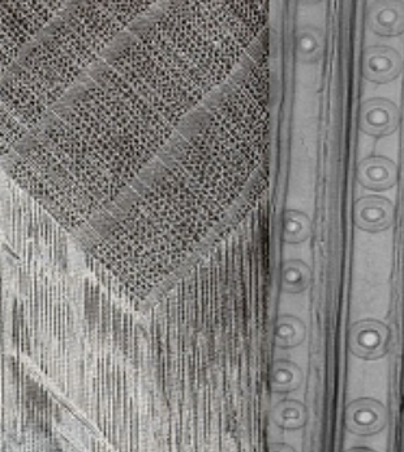
Cell structure in wood fibers
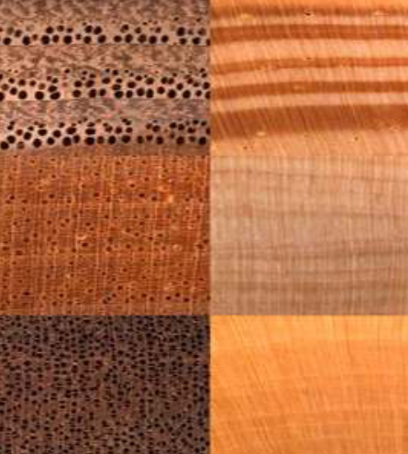
Transverse and longitudinal sections of various woods
| Wood Type | WEIGHT Kg / m3 | |||
| Full Dry | Air-Dry | Fresh | ||
| Uncut | 980 | |||
| Pine | 490 | 510 | ||
| Alburnum | 550 | |||
| Uncut | 960 | |||
| Spruce | 430 | 460 | ||
| Mature | 520 | |||
| Uncut | 980 | |||
| Fir Tree | 520 | 540 | ||
| Mature | 510 | |||
| Uncut | 1060 | |||
| Beech | 670 | 710 | ||
| Alburnum | 970 | |||
| Crossbreed | 550 | 580 | – | |
| Oak | 650 | 680 | 1000 | |
| Ash Tree | 650 | 680 | 860 | |
| W. Acacia | 720 | 760 | – | |
| Poplar | 410 | 440 | – | |
| Alder Tree | 490 | – | 930 | |
| Maple | 590 | – | 970 | |
| Chestnut | 486 | – | 1060 | |
| Elm Tree | 640 | – | 1120 | |
Due to the cell structure of the wood, it is a good heat insulator because it has an air gap.
The coefficient of thermal conductivity increases as the specific weight of wood increases. The heat value of wood varies with its specific weight and its resin, tannin, lignin and moisture content. Heat value increases with increasing specific weight. As specific weight increases, so does the thermal expansion in the radial and tangential directions in direct proportion (KOLLMANN, 1951).
An increase in specific weight of wood results in an increase in dielectric constant, resistance to sound propagation, and sound absorption value, while electrical resistance and adhesion friction decreases.
There is a direct proportional relationship between the modulus of elasticity in wood and the increase in specific weight. Generally in all types of wood, there is a correlation between increased specific weight and improved resistance properties.
KNIGGE – SCHULZ (1966) indicate that among the static resistances, the specific weight of wood affects the tensile strength most, followed by bending, shearing, and compressive strength. With the increase of the specific weight, the cleavage resistance increases more in deciduous trees than in conifers. As the specific weight increases, the torsional strength also increases in direct proportion.
Studies conducted by BERKEL (1960) on Eastern Ladine and studies conducted by BERKEL – BOZKURT – GÖKER (1969) on Oaks indicate that there is a direct correlation between Brinell hardness and specific weight . Furthermore, the processing properties of wood vary with specific weight; and as a parameter, heavier woods are better processed and provide a smoother surface. However, more force is required in the processing of heavy wood (KURTOĞLU, 1981).
One method of measuring frequency in wood is the LUCCHIMETER. The LUCCHIMETER is a measuring instrument. Calculations on the function of the relevant instrument can be found on its website.
We will try to explain another method with an example;
Surface area (1.2)= (( a + c )/2)* b
Volume of wood = (( surface1 + surface2 )/2)* d.
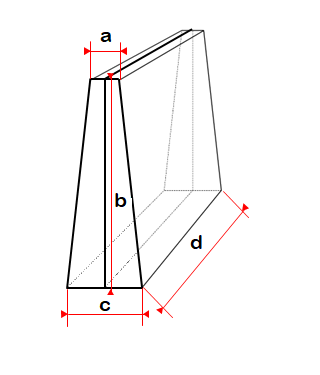
The figure above depicts a drawing of a processed violin wood. The dimensions measured after the processing of the wood in the middle is depicted as follows;
H=a/2 ; W=b ; L=d
Let the dimensions of a plate be as follows for our example; H=1.3 cm, L=43.75 cm, W=11 cm.
Accordingly, the volume can be found as;
V = HxLxW = 1.3×43.75×11 = 625.6 cm3
On the other hand, let’s assume that the weight of the wood material measured on a precision mechanical balance was 337.3 g. Accordingly, the specific weight can be found as;
specific weight ( y )= weight / volume = 337.3 / 625.6 = 0.54 g/cm3.
Typical results are in the range 0.38 – 0.45 for spruce and 0.50 – 0.60 for maple.
Radiation rate is found via c/y formula.
In this formula, c equals to speed of sound.
Speed of sound = ( 0.98 x F x L2 ) / ( 100 x H ). In this formula;
F = Frequency ( Hz )
L = Length of wood material (cm)
H = Thickness of the wood material (cm).
According to the formula, the speed of sound is found as follows;
C =[0.98 x 447 x ( 43.75 x 43.75)] / ( 100 x 1.3 ) = 6449,80 m/s.
The radiation rate RR equals to c/y; therefore;
RR = 6449.80 / 540 = 11.9.
If the RR value found is interpreted according to the scientific chart given below, the RR value and the sound velocity corresponding to the density of the maple tree calculated in the example give very high values. This indicates that wood is very good at transmitting the speed of sound.
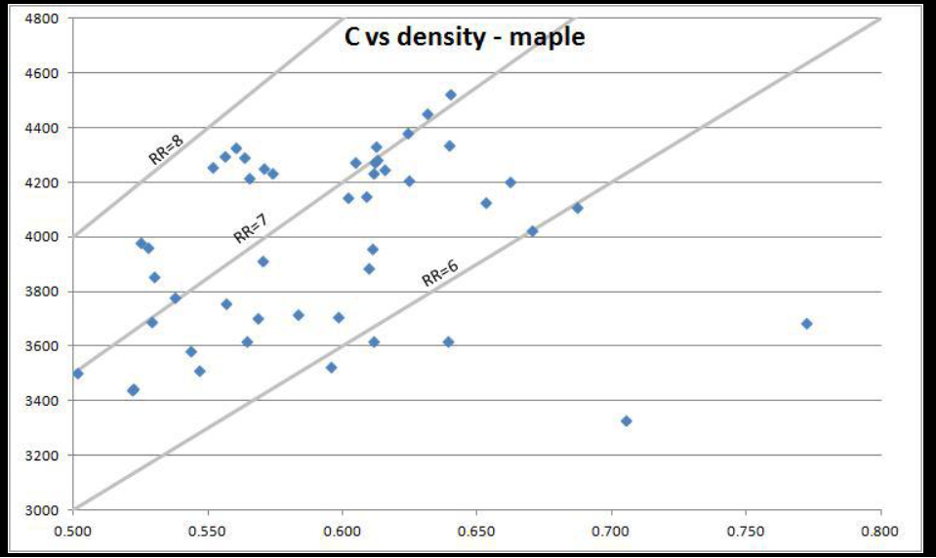
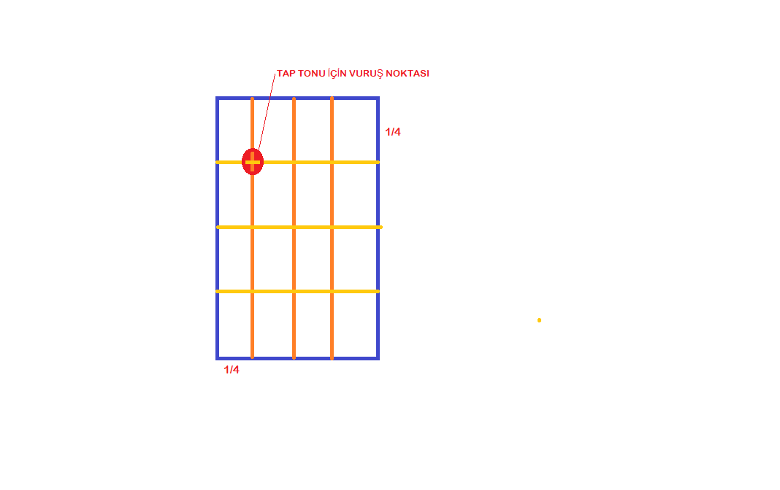
Moreover, tap tone of the wood is determined by the frequency (F) in our formula. This frequency is measured using a microphone, audio measurement software and a sound hammer. The second knuckle of the middle finger can be used instead of the sound hammer. In order to obtain a tap tone sound, you can do the following. When you think that you have divided the wooden piece in your hand into four equal parts in terms of width and length, the intersection point of the first segments is the point where you will tap to get the tap tone. We discovered the Tap tone to be 447 Hz with this procedure.
TAP POINT FOR TAP TONE
In short, we have brought a different perspective to the physical and acoustic properties of the wood material to be used in the violin. Regardless of the scientific approach we use in wood selection, there is never a solution that we can call a definitive wood selection method. The selection of appropriate wood truly necessitates specialized experience and knowledge. PREVIOUS EXPERIENCES LAY THE FOUNDATION FOR SEEKING NEW VIOLIN WOODS!
December 1994,Trabzon, Uluer VARDALOĞLU
